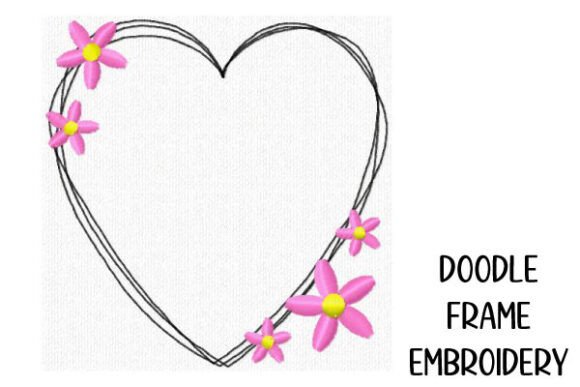
Heart Doodle Frame with Flowers
A Sketchy Charm That Feels Hand-Drawn—Not Just Machine-Made
First impression? This isn’t a stiff, symmetrical heart. It’s a soft, slightly uneven doodle—like something you’d sketch in the margin of a love note. The floral accents curl organically around the frame’s edge, not rigidly spaced or overly uniform. There’s breathing room between elements, and the “sketchy stitching” effect (likely achieved through controlled running stitch or light satin stitch) gives it warmth and approachability. It doesn’t scream “Valentine S Day” in a clichéd way—it whispers romance, nostalgia, and quiet intention. That makes Heart Doodle Frame with Flowers especially strong for handmade products where authenticity matters more than polish.
Where It Shines: Real Projects, Real Customers
I recently tested Heart Doodle Frame with Flowers on a natural linen tea towel for a small-batch boutique order—and it landed perfectly. The design sat comfortably centered above a monogrammed initial, neither overwhelming the fabric nor disappearing into its texture. It also worked beautifully as a sweatshirt embroidery for a bridal shower gift: stitched in soft blush thread on heather grey cotton, the doodle frame felt personal, not mass-produced. As a machine embroidery design, it holds up well on medium-weight fabrics like denim tote bags, cotton aprons, and pillow covers—especially when paired with a lightweight cutaway stabilizer. Its open layout avoids heavy fill stitch clusters, so it breathes on baby onesies and nursery decor without stiffness or bulk.
For Etsy sellers and craft business owners, this is a versatile digital embroidery file that bridges seasonal and evergreen appeal. Yes, it fits Valentine S Day and wedding projects—but it’s equally at home on spring-themed kitchen towels, Mother’s Day aprons, or personalized graduation gifts. Unlike dense floral monograms or overwrought script designs, Heart Doodle Frame with Flowers leaves space for names, initials, or short messages without crowding. That flexibility means less custom digitizing work for you—and faster turnaround for clients.
Where to Proceed With Care
This design isn’t magic on every surface. On stretchy knits like t-shirts or baby bodysuits, the sketchy lines can blur if stabilizer isn’t layered thoughtfully—opt for a tear-away + cutaway combo, and avoid hooping too tightly. Thin fabrics (think voile or lightweight chambray) need extra backing to prevent show-through, especially in the sparser floral corners. And while the doodle style forgives minor alignment shifts, curved surfaces like caps or baseball hats demand precise placement—test on scrap first, and consider simplifying or repositioning floral accents if distortion pulls the heart shape out of proportion.
Dark fabric is another moment to pause. The sketchy effect relies on contrast; on black or navy, fine running stitch details may recede unless you choose high-contrast thread (e.g., white or metallic silver) and verify stitch density isn’t too sparse. Likewise, frequent washing weakens delicate running stitches over time—so for kitchen towels or baby items meant for heavy use, reinforce high-friction zones or suggest gentle care to customers.
How It Shapes Perception—And Why That Matters
Customers don’t just buy embroidery—they buy feeling. Heart Doodle Frame with Flowers reads as handmade, thoughtful, and intentional. That perception lifts perceived value: a $28 embroidered tote bag feels worth the price when the design looks like it was drawn just for that piece—not dropped from a generic clipart library. For small shop owners, that translates directly to trust and repeat buyers. For apparel decorators, it adds personality to otherwise plain sweatshirts or caps without sacrificing professionalism.
It also supports brand consistency. Because the frame is modular—not tied to one font or color scheme—you can adapt it across product lines: soft pastels for baby embroidery, earthy tones for boutique kitchen goods, bold contrasts for modern holiday embroidery. And unlike complex applique design layouts, this machine embroidery design scales cleanly from 3” to 5” without losing legibility—making it ideal for both embroidered patch production and printable mockups used in Etsy listings.
Designer Notes You’ll Actually Use
- Always test on scrap fabric first—especially with textured weaves or dark backgrounds.
- Check thread color contrast before stitching full runs; soft hues can vanish on similar-toned fabrics.
- Review stitch density visually: look for gaps in the doodle lines or overcrowded floral tips—adjust if needed.
- Confirm hoop size compatibility before digitizing additions (like names)—some versions may push tight margins.
- Inspect small details at 200% zoom: ensure floral stems and heart curves remain clean, not jagged or pixelated.
- Test black-and-white mockups to gauge how the design reads without color context.
- Compare light and dark fabric backgrounds side-by-side to assess visibility and balance.
- Use proper stabilizer—lightweight cutaway for stability, tear-away for quick removal on stable fabrics.
- Verify licensing terms before selling finished products or bundling the digital embroidery file—commercial use isn’t automatic.
- Ask yourself: does this support my brand voice? If your shop leans minimalist or industrial, this doodle frame may feel off-brand—even if it’s well-digitized.
Final Thought: A Design That Invites Connection
Heart Doodle Frame with Flowers won’t win awards for technical complexity—but it wins where it counts: in how people respond to it. A bride smiled when she saw her initials nestled inside it on a guestbook cover. A mom paused mid-scroll on Etsy when she spotted it on a linen baby blanket. That’s the quiet power of a well-judged embroidery project: it doesn’t shout. It connects. Use it intentionally—with attention to fabric, thread, and context—and it becomes more than decoration. It becomes part of someone’s story.