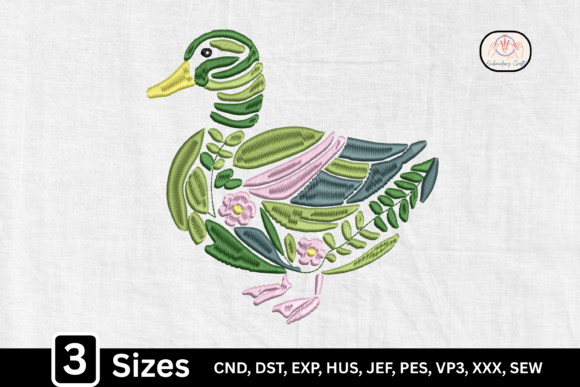
Botanical Floral Duck
A Soft, Thoughtful Shape—Not Just Another Bird Design
When I first opened the Botanical Floral Duck embroidery file, what struck me wasn’t just the charm—but the intention behind it. This isn’t a bold, graphic duck silhouette or a cartoonish motif. It’s a quiet, layered composition: petals curling into wings, stems tracing the curve of a neck, leaves fanning gently from the tail. The soft pastel florals aren’t scattered; they’re orchestrated. As a designer who regularly selects machine embroidery designs for client work—from boutique baby blankets to custom aprons—I immediately saw how this shape would settle into real fabric: not shouting, but inviting closer looking.
Where It Lives Best: Tote Bags, Nursery Pillows, and Thoughtful Gifts
Last week, I prepped a small batch of linen tote bags for a local herbalist’s shop—each meant to hold dried lavender bundles and handwritten thank-you notes. I tested Botanical Floral Duck centered on the front panel, 4.2" wide. On natural linen with ecru thread, it read as calm, grounded, and quietly elegant. Customers didn’t just see “a duck”—they paused. They noticed the tiny bud tucked behind the ear, the subtle gradation in leaf fill stitches. That’s the difference between decoration and storytelling. For handmade product makers, that pause is where trust begins.
It also translated beautifully onto a cotton muslin baby pillow cover (3.8" version), stitched with lightweight cutaway stabilizer. The design’s open layout—more breathing room than dense coverage—meant no stiffness, no puckering, and zero risk of overwhelming delicate fabric. That’s rare in bird-themed embroidery files, which often lean heavily into satin-stitched feathers or tight fill areas.
What Holds Up—and What Needs Extra Care
Botanical Floral Duck performs well on stable, medium-weight fabrics: canvas, quilting cotton, twill, and midweight knits (with proper stabilizer). I’ve used it on sweatshirt fleece with success—but only when hooping tightly and using tear-away + light cutaway combo. The floral elements are spaced thoughtfully, so stitch density stays balanced—not too sparse to lose definition, not so dense it gums up textured surfaces.
That said, avoid it on ultra-thin voile or highly stretchy jersey without significant testing. Some of the finer botanical lines (especially the slender stem leading into the duck’s beak) can blur if tension isn’t dialed in or if stabilizer shifts. And while it reads clearly on light fabric, I’d skip dark backgrounds unless you’re willing to test thread contrast thoroughly—pastel greens and blush pinks fade fast on navy or charcoal without tone-matched thread or underlay adjustments.
Caps and curved surfaces? Possible—but only at 3.0" or smaller. The duck’s profile flows naturally along gentle curves, but the lower leaf cluster tends to distort near the bill if stretched across a high-crown cap. Save it for flat or softly contoured items: tea towels, pillow fronts, pocket accents on overalls, or embroidered patches meant for jackets and backpacks.
Why It Builds Brand Trust—Especially for Small Shops
As an Etsy seller and craft fair vendor, I know customers don’t buy embroidery—they buy *feeling*. Botanical Floral Duck delivers warmth without cliché. It avoids the overly sweet or twee trap common in baby or nursery embroidery. Instead, it feels intentional, grown-up, and quietly skilled—like something you’d find in a thoughtful independent stationery brand or a slow-living lifestyle shop.
That perception lifts perceived value. A $32 linen apron with this design stitched cleanly on the chest reads as curated, not mass-produced. A personalized holiday kitchen towel featuring Botanical Floral Duck and a monogram feels like a gift you’d wrap carefully—not tuck into a stocking as filler. For creative entrepreneurs, that distinction matters. It supports pricing confidence and repeat buyers.
Practical Designer Notes Before You Stitch
- Always test on scrap fabric first—especially if pairing with textured weaves or blending thread colors beyond the suggested pastels.
- Check small details in black-and-white mockups. Some floral accents may vanish on low-contrast backgrounds; adjust thread hue or add subtle underlay if needed.
- Confirm hoop size compatibility. The full design likely needs at least a 5x7 hoop—but verify before digitizing or resizing for commercial embroidery runs.
- Review stitch order. Does the beak outline stitch before or after the surrounding petals? That affects clean layering on multi-step projects like applique designs.
- Use appropriate stabilizer: lightweight cutaway for wovens, tear-away + topping for knits, and always test wash durability if marketing as a finished product for baby or kitchen use.
- Verify licensing. If selling physical items or digital embroidery files, confirm whether Botanical Floral Duck permits commercial use—or requires attribution, limits on quantity, or exclusivity clauses.
Final Thought: A Design That Grows With Your Work
Botanical Floral Duck isn’t flashy—but it’s reliable in the way seasoned designers value most. It adapts: scale it down for a delicate patch, simplify one floral cluster for a minimalist tea towel, or pair it with hand-lettered script for a wedding guest towel set. It doesn’t dominate a garment—it complements it. And in a market saturated with loud, trend-driven embroidery files, that kind of quiet versatility is quietly powerful.
Whether you’re stitching for your own craft business, building a cohesive line of nursery decor, or sourcing design assets for digital product bundles, Botanical Floral Duck earns its place—not as background filler, but as a considered, human-centered detail. That’s the kind of embroidery that gets touched, remembered, and passed down.